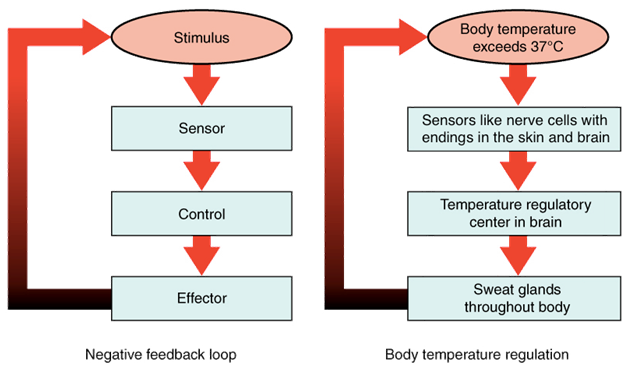
Homeostasis is the body’s ability to keep a reasonably stable environment inside your body as the world you live in throws everything it has at you.
All living organisms from plants to animals to people must maintain a balanced internal environment to survive. If your blood pressure gets too high or low or your body temperature increases or decreases too much, your vital organs may have a problem doing their jobs which could cause a domino effect ending in death.
How Homeostasis is maintained
Your brain does a tremendous job 24 hours a day, 365 days a year, never stopping. Its’ job is to keep all your body’s systems in check, make sure “everyone” checks in, and reports all clear.
Your brain listens for either the “all clear” signal or a distress signal from the various parts of your body. Your nervous system, like the wires in a computer, is connected from all parts of your body back to the brain.
Let’s say you touch something hot, like a hot stove. Before you can even blink, signals are sent through the nervous system from your fingers to your brain about the problem – TOO HOT! Your brain leaps into action and tells your motor functions to remove the hand from the source of this problem which in turn makes you quickly pull your hand away to avoid the problem.
Role of Homeostasis in Diabetes
Diabetes, another example of a homeostatic problem, is a disease that is caused by a broken feedback loop involving the hormone insulin.
Because the insulin level sensors cannot transmit its signals (information) to the brain your body cannot respond quickly enough to changes in your blood sugar levels.
In a healthy person, two hormones – insulin and glucagon control blood sugar levels. Insulin is responsible for decreasing blood glucose levels. After you eat a meal, your blood glucose levels will rise. Your body will further release insulin from special cells in the pancreas. The insulin tells other cells in your body, such as fat and muscle cells, to use the glucose for fuel.
Insulin also converts glucose into glycogen in the liver. Both of these methods pull the sugar out of the blood, which brings your blood sugar levels down, which reduces the insulin release and returns the whole system to homeostasis.
Diabetes causes a lot of problems for a lot of people but it can be controlled.
Your local Nashville clinic, Cape Sierra Family Clinic, can help you understand your diabetes and help you keep it in check.
Cape Sierra Family Clinic can also help with many other problems that can affect your homeostasis (balance) in the body.
Give us a call today at 615-396-8997 to learn more and find out how to easily keep your body in balance and maintain a healthy lifestyle for many years to come.